KiwiRail reviews Traffic Management Plans (TMPs) that may affect the safe operation of the rail network. All TMPs must also follow the NZGTTM risk‑based approach, which requires road controlling authorities and contractors to identify and manage risks to road users, workers and rail users.
This page outlines when TMPs must be submitted to KiwiRail, when a Permit to Enter (PtE) is required, and when a Rail Protection Officer (RPO) may be assigned.
You must submit a TMP to the Corridor Access Team when any of the following apply:
A. Work near a level crossing
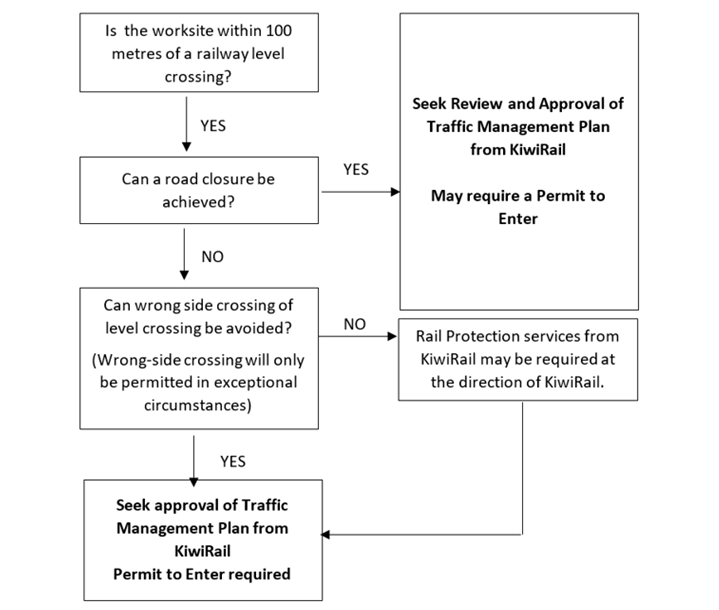
All draft TMPs within 100 metres of any level crossing must be reviewed by KiwiRail to confirm that the proposed layout does not create new risks.
B. Work near the rail corridor
Work within 10 metres of the track must be notified to KiwiRail with a TMP.
The rail corridor extends 5 metres either side of the track however on occasions, KiwiRail owns land beyond 5 metres.
C. TMPs that may affect traffic flow near rail
You must send the TMP if the works may cause:
Even if the work is not directly beside the rail corridor, any road layout that can cause vehicles to stop or queue over a crossing must be reviewed by KiwiRai.
Reducing a crossing or its approach to one lane can create significant safety risks. These include:
If your TMP reduces the crossing or approach to one lane, you must submit it to KiwiRail.
Your TMP must not block sightlines to level crossing lights, bells, signage or other warning devices. KiwiRail may request additional details on how queueing and road user behaviour will be managed..
Once the TMP has been reviewed by KiwiRail and approved by the relevant roading corridor manager, the final approved TMP must be submitted to KiwiRail.
This confirms that all identified safety requirements have been addressed.
A Permit to Enter is required when:
Exceptions are at the discretion of the Corridor Access Team.
If your work or your workers are inside the corridor at any point, a PtE is required.
KiwiRail may assign an RPO when traffic management introduces risk at a level crossing. Examples include:
KiwiRail will confirm RPO requirements during the TMP review.
TMPs must comply with both KiwiRail requirements and NZGTTM expectations.
NZGTTM Requirements:
KiwiRail Requirements:
In short:
NZGTTM sets the road‑side standard.
KiwiRail sets the rail‑side standard.
Contractors must meet both.
Send all Traffic Management Plans for proposed works to: Corridor Access Team
This supports review of level crossing safety, road and rail interface risks and any permit requirements.
1. WorkSafe guidance for road workers working near the rail corridor
2. Traffic management considerations (decision chart)