Step 1: Check if you need a Permit
If your work involves installing assets, occupying land, or using KiwiRail property for any ongoing purpose, you may need a formal property agreement, prior to obtaining a Permit to Enter. This includes moving livestock. Please visit Property for more information.
Working within 5 metres of the mainline
Any work or personnel within 5 metres of an operational track requires a PtE for safety and compliance. This includes drone activity.
Traffic Management Plan (TMP) review
If your work includes traffic management and is within 10 metres of track or within 100 metres of a level crossing OR it may affect traffic flow near rail, a PtE enquiry is required so KiwiRail can review and approve the TMP. TMP's must comply with both KiwiRail requirements and NZGTTM expectations.
KiwiRail reviews Traffic Management Plans (TMPs) that may affect the safe operation of the rail network. All TMPs must also follow the NZGTTM risk‑based approach, which requires road controlling authorities and contractors to identify and manage risks to road users, workers and rail users.
This page outlines when TMPs must be submitted to KiwiRail, when a Permit to Enter (PtE) is required, and when a Rail Protection Officer (RPO) may be assigned.
1. When You Must Send KiwiRail a TMP
You must submit a TMP to the Corridor Access Team when any of the following apply:
A. Work near a level crossing
All draft TMPs within 100 metres of any level crossing must be reviewed by KiwiRail to confirm that the proposed layout does not create new risks.
B. Work near the rail corridor
Work within 10 metres of the track must be notified to KiwiRail with a TMP.
The rail corridor extends 5 metres either side of the track however on occasions, KiwiRail owns land beyond 5 metres.
C. TMPs that may affect traffic flow near rail
You must send the TMP if the works may cause:
- cause traffic queues near a crossing
- slow or back up traffic
- change how vehicles approach a crossing
- create new risks at the road–rail interface
Even if the work is not directly beside the rail corridor, any road layout that can cause vehicles to stop or queue over a crossing must be reviewed by KiwiRail.
2. One‑Lane Operation Near a Level Crossing
Reducing a crossing or its approach to one lane can create significant safety risks. These include:
- vehicles queueing over the tracks
- vehicles becoming trapped between barrier arms
- Stop/Go paddles blocking escape routes
- distraction or reduced visibility of rail warning systems
- road users missing or misinterpreting rail warning signals
- reduced visibility approaching the crossing
If your TMP reduces the crossing or approach to one lane, you must submit it to KiwiRail.
Your TMP must not block sightlines to level crossing lights, bells, signage or other warning devices. KiwiRail may request additional details on how queueing and road user behaviour will be managed.
3. Final TMP Submission
Once the TMP has been reviewed by KiwiRail and approved by the relevant roading corridor manager, the final approved TMP must be submitted to KiwiRail.
This confirms that all identified safety requirements have been addressed.
4. When a Permit to Enter (PtE) Is Required
A Permit to Enter is required when:
- work is within the rail corridor (5 metres either side of the track)
- any personnel will enter the corridor
- any plant or machinery is within 5 metres of the rail
- KiwiRail identifies safety or operational risk during TMP review
- the work may influence train operations
Exceptions are at the discretion of the Corridor Access Team.
If your work or your workers are inside the corridor at any point, a PtE is required.
5. When a Rail Protection Officer (RPO) May Be Required
KiwiRail may assign an RPO when traffic management introduces risk at a level crossing. Examples include:
- queueing or stopped vehicles near or on the crossing
- potential for vehicles to be trapped by barrier arms
- limited sightlines or high traffic volumes
- any situation where rail operations may be affected by road activity
KiwiRail will confirm RPO requirements during the TMP review.
6. NZGTTM and KiwiRail Requirements
TMPs must comply with both KiwiRail requirements and NZGTTM expectations.
NZGTTM Requirements:
- TMPs must follow a risk‑based planning approach.
- TMPs should use NZGTTM‑aligned forms and include risk assessments.
- Vulnerable road users (pedestrians, cyclists, mobility‑impaired) must be considered.
- Temporary traffic management must not obscure level crossing warning devices or block sightlines.
KiwiRail Requirements:
- KiwiRail must review TMPs within 100 metres of all level crossings.
- KiwiRail must be notified of all works within 10 metres of the track.
- A PtE is required for any work inside the rail corridor or near live tracks.
- KiwiRail may require additional risk controls, including RPOs.
- Final approved TMPs must be submitted back to KiwiRail.
- KiwiRail may request additional evidence where TMPs impact crossing safety or traffic flow.
In short:
NZGTTM sets the road‑side standard.
KiwiRail sets the rail‑side standard.
Contractors must meet both.
7. Submitting TMPs to KiwiRail
Send all Traffic Management Plans for proposed works to: nationalpermits@kiwirail.co.nz
This supports review of level crossing safety, road and rail interface risks and any permit requirements.
8. Best Practice Guidance
1. WorkSafe guidance for road workers working near the rail corridoropen_in_new
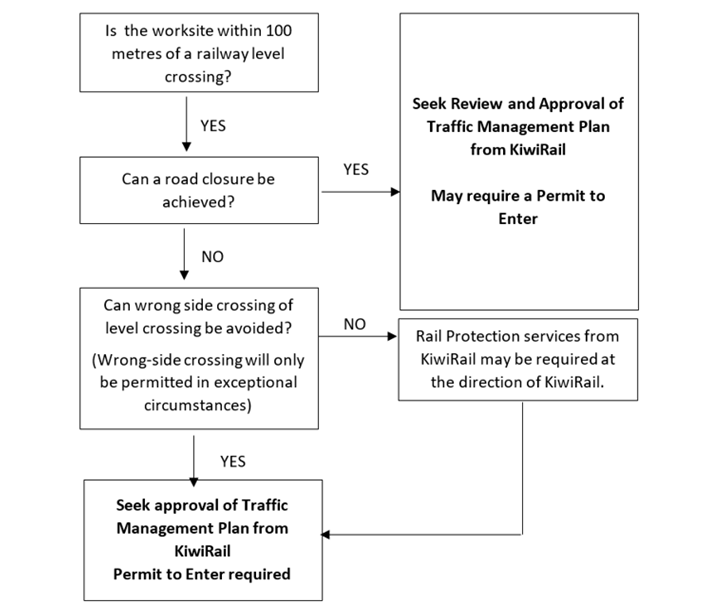
2. Traffic management considerations (decision chart)open_in_new
Work near electrical overhead wires
Electrical work may require an additional Electrical Safety Permit or Permit to Work Near Railway Power Lines.
Work inside KiwiRail facilities
Any work within five metres of mainline rail in operational facilities (e.g., mechanical or service areas) requires appropriate permission, which may include a PtE.
Over‑Dimension and Over‑Weight Loads
Over‑dimension and over‑weight loads are larger or heavier than standard road vehicles. These loads can cross a railway line, but you must obtain a Crossing Permit before doing so.