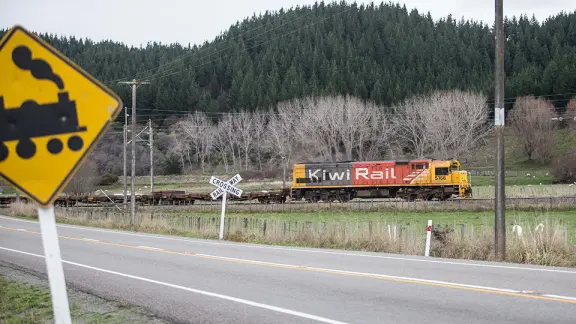
Living by the rail network
Information for people living next to the railway, including property boundaries, fencing,
Questions?
Noise and vibration
Transport operations (whether by rail, road or air) inevitably create noise.
What to expect and what to do if it’s affecting you.
- The daily running of the rail network generates a certain amount of noise and vibration.
- Our maintenance and improvement work on the rail network can also generate noise.
- Noise will vary depending on circumstances including how close you are to the rail network, the presence of noise insulating material, ground conditions and other sources of noise in the area.
- We work hard to reduce noise, but a certain level is unavoidable.
Common sources of noise
Vibration
- If you are concerned that trains running near your property are causing structural damage, we recommend you provide us with a report from an independent surveyor.
- If the report indicates that KiwiRail’s operations are causing vibration and damage, we will investigate.
Friction
- Friction can cause a train entering or leaving a curve on the track or passing over a joint in the rail to make a high-pitched ‘whine’.
- This can be affected by a range of factors including track formation, rail condition, and weather.
- The noise is produced by contact between the metal train wheel and the top or side of the metal rail.
- Train brakes can create a similar squealing sound from contact between brake pads and brake disks.
- A level of friction is necessary for trains to operate effectively and to brake in a safe and controlled way, so some noise can always be expected.
- KiwiRail works with Auckland Transport in Auckland and Metlink in Wellington to monitor friction and methods to minimise associated noise, where practicable. This includes track and wheel lubricators.
Train horns
- We need to provide safety warnings to people who are on or near the tracks.
- Horns are a vital safety feature for trains that run on our network.
Yard and depot operation
- There can be noise associated with loading and moving wagons in our freight yards and depots.
- Our yards can operate 24 hours a day, seven days a week.
- We run trains and move goods to meet our customers’ requirements to move freight around New Zealand.
- KiwiRail is required to comply with any noise conditions included in designations that authorise yard operations.
Level crossings
- Noise from a level crossing can be caused by vehicles crossing it.
- Although we can sometimes reduce noise by making the crossing surface smoother, it can rarely be eliminated completely.
- Noise is also generated by some of the safety alarm systems installed at level crossings.
- Warning bells are an essential safety device and warn people that a train is approaching.
Trees and vegetation
KiwiRail maintains vegetation on railway land to an industrial standard, with limited budget.
To manage vegetation effectively, we prioritise and schedule work carefully.
KiwiRail's top priority is dealing with vegetation on rail land that is a risk to safe rail operations and/ or poses a risk to members of the public.
If there is vegetation on our land that is dangerous, please let us know immediately: 0800 808 400 (emergency).
Property owners are responsible for managing vegetation on their land and ensuring it does not encroach on the rail corridor.
If you have concerns about vegetation on KiwiRail land, please contact us.
Essential maintenance
Our teams work around the clock seven days a week making sure the track and other infrastructure are well maintained so train services can operate safely. And as services continue to increase, so will the amount of maintenance needed to keep trains running safely.
If you use the trains
We understand that any track closures or journey delays are frustrating. We are working to minimise overall disruption for passengers and for those who live and work alongside the rail corridor.
To keep our teams safe, much of our work must be done when no trains are running. We work closely with Auckland Transport to plan maintenance activities. We do our best to close the network at times when fewer people are travelling – eg, overnight, at weekends and public holidays. However, there are times when it makes more sense to close the track for an extended period, as it allows far greater productivity for KiwiRail's work teams and minimises the overall disruption.
To find out more about travel during track closures visit hereopen_in_new.
Living by the rail line
If you live near the rail corridor you are likely to notice a lot more work being done on the rail network, particularly at night or over weekends.
We do our best to work as quickly and quietly as possible, but some activities do create noise. We aim to give advance notice to neighbours when disruptive work is planned for more than 2 nights in a row.
As maintenance and construction activities increase, KiwiRail is encouraging neighbours to:
- Sign up for our email updates by emailing contactus@kiwirail.co.nz
- Regularly check our website: ‘where we are working’
Our work
Our teams carry out several different types of work on the rail network:
- Short notice maintenance activity
- Planned maintenance works
- Major track renewals
- Network upgrades
Short notice maintenance activity
These usually involves urgent track repairs and maintenance that have been noted through our regular routine inspections and need to be done immediately to ensure that trains continue to run safely. The work will usually take place at night, and there is not always time to advise nearby residents in advance. However, it is usually able to be completed within a short time frame.
Regular planned maintenance activities
These activities are usually planned in advance and happen regularly across the Auckland network and include:
- Destressing – this stretches and tightens the rail to reduce track issues when rail heats and expands in summer
- Rail repairs and welding – keeps the lengths of rail securely joined
- Mud spots – cleaning up the foundation the rail and sleepers rest on
- Drainage works to clear drains and culverts
- Test trains and general track inspection works
Some of these activities require specialist machines and take place a few times a year. These include:
- Rail grinding – changes the shape of the rail to reduce the stress on it as trains pass, and removes damaged rail
- Tamping – lifts the ballast (the stones beneath the track that give support) and then compacts it beneath the sleeper
- Ballast cleaning – a large machine scoops up the ballast, washes dirt out of it and replaces it beneath the sleepers
Most of this work is not particularly noisy so we will only give advance notice in instances when it may be more disruptive than usual.
Network upgrades
These are major projects to improve the rail network so it can support more frequent and reliable train services. These projects are usually delivered in a fixed location across several months or years.
Corridor neighbours will always be given advance notice of these works.
Fencing and boundaries
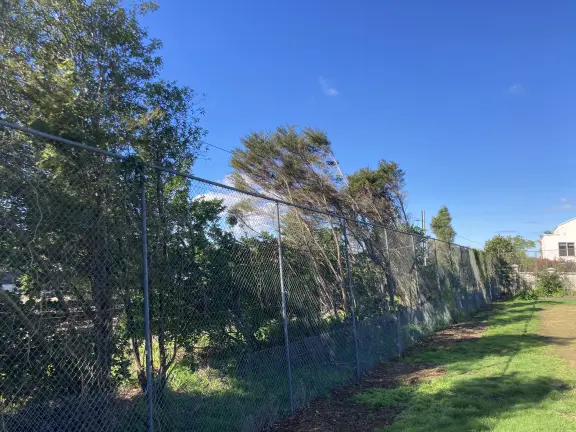
If your property borders the railway, it's your responsibility to know where your legal boundary lies and to ensure any fences or structures remain within it. KiwiRail generally does not contribute to boundary fencing costs under the Fencing Act 1978. We recommend fencing rail boundaries where children, pets or livestock may be present. Existing railway fencing may not be suitable for containing animals.
Private level crossings
Private level crossings provide access across the railway to private land and are common in rural areas. If you purchase a property with a private level crossing, you must apply for a grant that gives you the legal right to use it.
KiwiRail and the grant holder share responsibility for managing the crossing safely. The grant holder is responsible for maintenance and upgrade costs and for ensuring users operate the crossing safely.
Please note:
-
KiwiRail may close a crossing if safety concerns arise.
-
Alternative legal access to your property should always be available.
-
New subdivisions must have legal road access and cannot rely solely on a private level crossing.
-
To enquire about a private level crossing, email level.crossings@kiwirail.co.nz.
New level crossings
-
Because level crossings introduce safety risks for both rail and road users, KiwiRail seeks to minimise the number of crossings on the rail network. Where new crossings are required, our preference is for grade-separated solutions such as bridges or underpasses.