Auckland Rail Programme Business Case
Auckland Rail Programme Business Case
The Auckland Rail Programme Business Case was jointly developed by KiwiRail and Auckland Transport across 2021-23.
It is a holistic assessment of the whole system of rail in Auckland and has developed the Strategic Rail Programme that will provide the reliability, resilience and room for growth that is needed to support the needs of all its users.
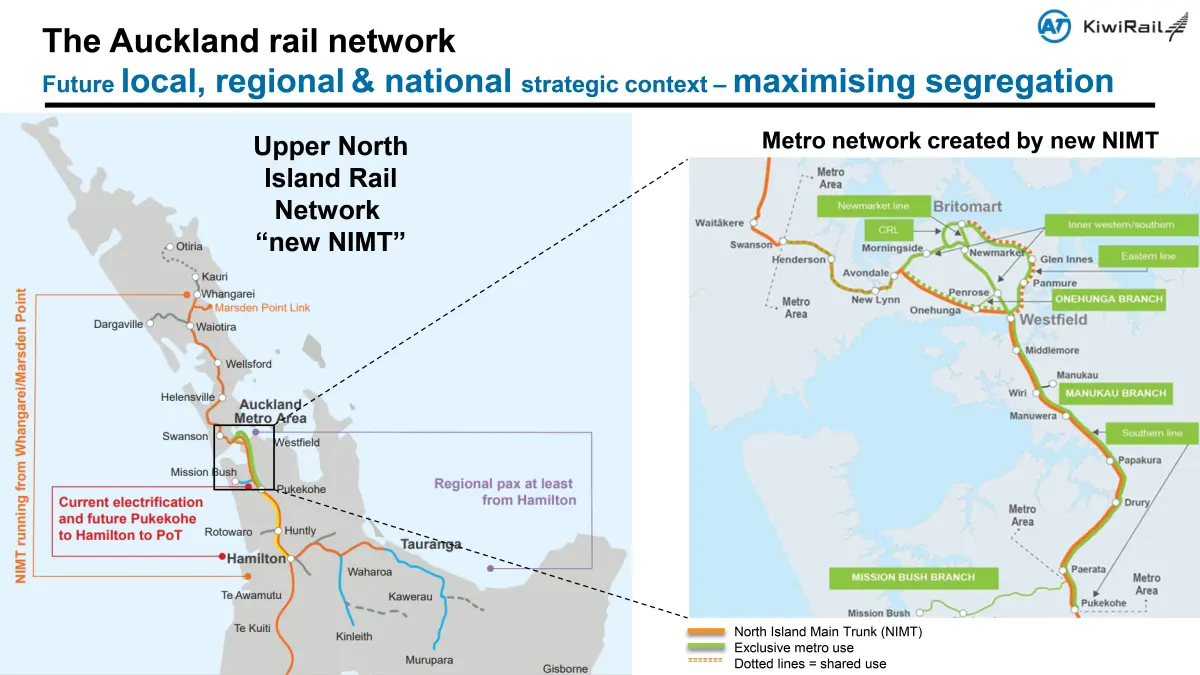
It also creates a long-term vision for the rail network in Auckland, encompassing its local, regional and national contexts.
The Auckland Rail Programme Business Case and associated documents are available via the below links. These include the “Rail Story” which is a high-level pre-read, and a summary of its outcomes as presented at the New Zealand Rail Conference in November 2023.
The Programme Business Case documents can be accessed via the following links:
Programme Business Case Appendices
Strategic Rail Programme: A 30-year vision
The Strategic Rail Programme has arisen from collaboration between KiwiRail and Auckland Transport via a Programme Business Case. It creates a vision for the rail network, its maintenance and resilience, and a strategic programme that will shape rail transport in Auckland over the next 10-30 years. An Economic Assessment of the programme is available below.
This long-term programme is holistic, addressing the entire rail system in Auckland – not only the need for new infrastructure and trains, but also their operation and ongoing maintenance and renewals. It provides:
- A 30 year forward look at what our rail network needs to be able to meet future demand (across a range of scenarios), from local, regional, and national perspectives
- Seeks to address long term aspirations for metro passengers, logistics operators and regional passengers
- Sets out a clear pathway and pipeline of planning and investment to make these plans a reality, including whole-of-life costs
- An exercise in resilience – each element of the Programme is a necessary part of a holistic programme of development, building on what we’ve got making it bigger, better, more reliable – able to do all the jobs we need from the system.
What are the benefits?
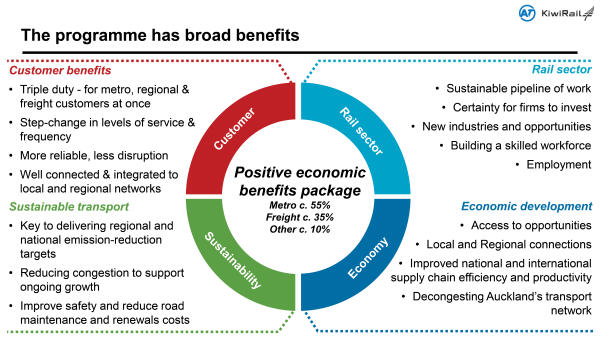
The Programme will create a broad range of benefits for all users, justifying the scale of investment. It represents planning to meet user needs across the next 30 years and provides the platform for ongoing growth into the future. It will help NZ reduce national transport emissions, provide a pipeline of employment and opportunities to invest, and support wider economic development.
Users will benefit from reliability, capacity and journey time improvements, as well as greater connectivity, resilience, and freight and supply chain efficiencies. This is not just about Auckland – it boosts inter-regional transport too (the third and fourth tracks) and creates economic benefits from more efficient freight supply chains, improving the efficiency of the golden triangle route and creating opportunity for regional growth.
What does it involve?
The benefits package is generated by the programme as a whole and it needs to be developed in a balanced way.
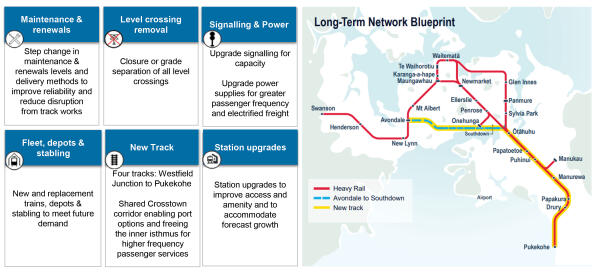
Some of the key elements of the programme include:
- Maintenance and reliability: step change in the extent of maintenance & renewals levels including modern plant and equipment, track access and delivery methods to improve reliability and reduce disruption from track works
- Four-tracking the Southern Line: Over the next 30 years, it is expected that an extra 130,000 people will call South Auckland home. We are already building a third line on the busiest part of the network, but to keep up with demand and allow more frequent journeys we want to extend the third track and build a fourth to improve journey times for commuters and separate fast and slow trains, positively impacting all customers using the Southern Line.
- Cross-town corridor (connecting west-east via Avondale to Onehunga) using land already owned by KiwiRail and designated for rail - that creates new connectivity across Auckland and is essential to maximising the long-term capacity, resilience and reliability of the existing system and our national freight and logistics supply chain as well as providing a passenger and freight link from East to West
- Level crossings removals across Auckland – this improves safety and, journey times, as well as increased service frequency. It also means cars and people are not waiting for extended times at closed barrier arms
- A separate programme is being run by AT to determine which crossings will be closed completely and which will be provided with an alternative (bridge or underpass).
There are also challenges
Affordability challenges will require further exploration of funding sources, including urban development opportunities created by rail development and new investment sources.
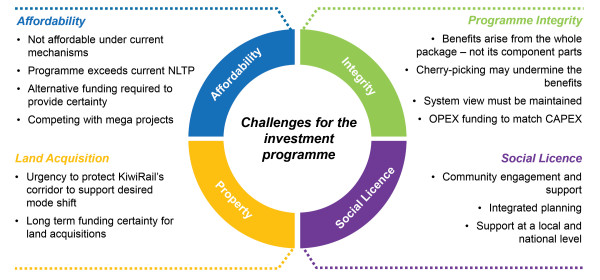
How was the strategic rail programme developed?
The strategic rail programme is the result of a two-year collaboration between KiwiRail and Auckland Transport on a Programme Business Case.
Alignment with wider planning:
- The Programme considered a variety of future scenarios, and the recommended infrastructure development has proven robust against significant changes (though urgency of investment could increase).
- The Programme was developed in alignment with wider Auckland Rapid Transit Network planning, notably that services to airport and the Northwest would be alternative modes. The Programme does not preclude extension in the future, should this be desired.
- Although the Programme is highly complementary to recent light rail plans, it is 100% independent. The cancellation of Auckland Light Rail planning has no material impact on the programme recommendations.
Next steps:
- The programme business case has been endorsed by both KiwiRail and Auckland Transport Boards.
- The Programme will require political will to progress, as well as seeking new funding solutions. Rail development can create significant urban and adjacent investment opportunities.
- In the short-term, investing in the planning phase for this Programme preserves the option to meet the forecast delivery profile without committing to the construction timing.
Economic impacts - Auckland Strategic Rail Programme
The Auckland strategic rail programme creates a vision for the rail network, its maintenance and resilience, and a strategic programme that will shape rail transport in Auckland over the next 10-30 years. It represents a nationally significant investment to create benefits at national and regional level.
To better understand its impacts across the NZ economy, KiwiRail commissioned a Computable General Equilibrium (CGE) analysis of the economic and emissions impacts of the 30-year strategic rail programme for Auckland (i.e. the recommendations of the Rail PBC 2023). The analysis extends to 2100 (i.e. 50 years beyond completion of the programme).
- The benefits from the collective rail investment include significant national and regional economic growth and national and international supply chain efficiency and productivity. On programme completion in 2050, national real GDP would grow by $2.2 billion per annum, rising to $6.6 billion to $7.3 billion per annum greater than it would have been by 2100.
- Emissions efficiency: per unit of economic output emissions will decrease as the programme changes the composition and location of generation. Long-term reductions in the transport, primary and manufacturing sectors can free emissions allowances for more productive uses. The transport emissions saving is 32.3Kt CO2-e by 2100.
- Employment and sector investment: As well as building and retaining a skilled rail sector workforce, the proposed investment programme provides a sustainable pipeline of work and certainty for firms to invest in rail. It is estimated that the investment programme would create 22,800 to 23,700 additional FTE jobs and increase average real wages.
The higher figures in the ranges shown above occur with earlier construction of the cross-isthmus Avondale-Southdown corridor. By contrast, delaying investment would reduce the scale of benefits from the programme.
National and regional benefits:
The investment proposed in Auckland’s rail system is significant and has benefits well beyond just Auckland. All other regions benefit; notably Wellington and the South Island would see real GDP more than $1 billion higher each in 2100 than it would otherwise have been.
Economic reports
This economic assessment and a socio-economic assessment of the value of New Zealand’s existing rail construction industry are available in the following reports and presentations.
The investment programme would create around 23,000 additional jobs in the New Zealand economy. This is on top of the industry that already exists and for which future pipeline is important. A socio-economic assessment of the value of this existing industry has also been undertaken.