Avondale to Southdown
The Avondale-Southdown rail corridor will play a key role in transforming both passenger transport in Auckland and freight movement in New Zealand.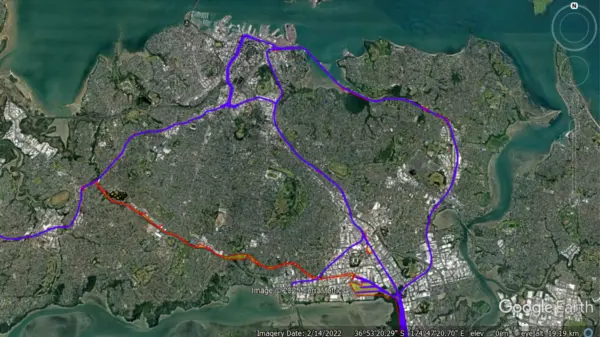
Acquired in the 1940s as part of an expansive rail plan for the city, the 13km east-west ribbon of land was intended to be developed for both passengers and freight. Substantial efforts over the last 80 years have ensured the route remains allocated for rail and an option for future.
The 30-year Strategic Rail Programme, launched at the end of 2023 by KiwiRail and Auckland Transport, clearly identified the Avondale-Southdown development as a critical part of Auckland’s and New Zealand’s future rail network, required in the next 15-20 years. The programme details the upsides of bypassing freight around the city centre (including reducing congestion), the benefits that the wider metro network gains from the addition, and the communities that would become better connected for future.
The potential line’s inclusion on the Government’s Fast-Track Approvals list in 2024 further reinforced the importance for this rail connection – often called “Auckland rail’s missing limb”.
Across 2025 and 2026 our Strategic Metro Investments team, with the help of expert agencies and consultancies, is undertaking the most thorough feasibility and scoping study of the rail corridor to date. Their primary objective is to protect the existing rail designation, which is due to lapse in 2029, and to progress initial planning. Additionally, they’ll be engaging with key stakeholders and compiling information about the corridor development opportunity.
While not yet funded, the overarching vision is to build the line and deliver the many benefits of improved rail infrastructure - for local communities, for Auckland, and for New Zealand - for generations to come
The Avondale-Southdown Project is investigating:
Pre-concept design: how might the line be constructed and be connected to the rest of the network?
National freight efficiency: How would this route potentially improve efficiency of freight movement between our ports? What would this mean for importers, exporters and the economy?
Passenger connectivity: How could this line interact with the existing public transport network? What positive impacts does it have on future passenger movements in the city?
Network resilience: How does the rail network benefit from a new line? How does it add capacity and reliability to the wider network?
Urban regeneration: Which neighbourhoods would benefit from the new line? What opportunities could be created for local communities?
Cost and revenues: What are the potential costs for creation of the line? How much revenue could be driven by it and how much would it cost to run?
Private sector investment: What opportunities are most appealing for private sector participation. How much could they fund?
Benefits
The Avondale-Southdown line would:
- integrate with the existing rail network - including City Rail Link – and offer better connections across the city.
- move freight trains away from the city centre, creating more efficient freight services for Kiwi businesses and exporters, and freeing up inner city capacity for passenger trains
- provide more viable public transport options across Auckland, contributing toward a reduction in traffic and congestion
- provide alternative routes when there are necessary maintenance or upgrade shutdowns on other parts of the network, as well as improving day to day reliability across the network
- connect communities across the isthmus, improving accessibility and creating greater access to employment and education opportunities
- create new urban development potential, such as more affordable housing and more vibrant shared community spaces
The corridor and its benefits are not solely about Auckland. It unlocks network access and benefits for neighbouring regions, and the wider New Zealand economy.
Read more about how the Avondale to Southdown corridor fits into our 30 -year vision - Strategic Rail Programme: A 30-year vision
Recent project findings
The Avondale-Southdown project team will be publishing reports from a number of workstreams over the next 12-18 months. Reports published so far include:
-
Multi Criteria Analysis Assessment Report: a high-level analysis of the proposed route and transport mode, using a framework aligned with NZ Transport Agency guidelines
-
Network Resilience Study Output Report: a dedicated study of network resilience by WSP to understand the operational benefits right across the isthmus that this strategic link could deliver under both normal and degraded conditions of the Auckland metro rail network.
Multi criteria analysis (MCA) – assessment report
Before beginning detailed work on the Avondale–Southdown Project, KiwiRail conducted a high-level analysis of the proposed route and transport mode, using a framework aligned with NZ Transport Agency guidelines. This early screening step was designed to inform current workstreams and support the development of a future business case.
In parallel, the team has been hosting local community leaders and stakeholders on tours of the Avondale–Southdown rail corridor. These tours aim to build understanding of the potential line, its benefits, and the process we're following to advance the project.
During these engagements, a small number of individuals asked whether the existing designation remains the best route, whether heavy rail is the most suitable mode and what other options have been thought about.
This report outlines the analysis process, presents the results, and demonstrates that alternatives have been properly considered.
The results in short: the analysis found heavy rail as the preferred mode, and the existing designation as the preferred route – as they deliver the strongest overall benefits across multiple criteria.
Read the full report: Avondale–Southdown: Multi Criteria Analysis Assessment Report (13 MB, Pdf)
Network Resilience Study Output Report
KiwiRail commissioned engineering consulting firm WSP to undertake a dedicated study of network resilience. It was created to understand the operational benefits right across the isthmus that this strategic link could deliver, under both normal and degraded conditions of the Auckland metro rail network. This workstream forms part of KiwiRail’s broader programme to protect the existing Avondale-Southdown designation and develop a robust case for future investment.
The study focuses on the corridor’s potential to improve network resiliency, capacity, and flexibility, particularly in the context of Auckland’s growing metro, freight, and interregional rail demands.
The report evaluates how AS could enhance service reliability, support higher train frequencies, and provide alternative routing options during planned maintenance or unplanned disruptions. It outlines the methodology applied, key assumptions, and the results of technical assessments, including capacity modelling and scenario testing.
Most importantly, it demonstrates the extent to which AS strengthens Auckland’s rail network performance and underpins long term transport objectives.
The results in short: The incorporation of the Avondale-Southdown rail corridor to Auckland’s isthmus rail network would unlock up to 32% extra capacity on the inner network – an increase that could otherwise only be achieved via substantial investment in widening those inner network corridors. It would improve network reliability (which will otherwise come under pressure due to sustained periods of demand at or in excess of available capacity), and would transform network performance during disruptions by providing alternative routings and faster recovery options.
Read the full report: Avondale–Southdown: Network Resilience Study Output Report (3.4 MB, Pdf)
What rail services would be run on the corridor?
The corridor is envisaged as mixed use like the rest of the rail network in Auckland. In practice, this would mean up to 8 metro passenger services per hour, connecting to the western and eastern corridors via Avondale, Mt Roskill and Onehunga.
There will also be space for freight services (most likely up to 5-10 trains in each direction per day, depending on how Northport grows) that would run between Northland and KiwiRail’s freight hub at Southdown (Onehunga) replacing the existing route via Newmarket. Also connecting at Southdown are existing freight services on the southern corridor from Tauranga, Hamilton and Wellington.
What is “heavy” rail?
It means conventional metro rail. “Heavy” is a term that started to be used to differentiate light rail proposals from the existing conventional or metro rail but seems to be creating confusion. To be clear, the trains and types of services proposed to operate on the Avondale-Southdown corridor are the same as on the rest of the network in Auckland.
Wasn’t light rail going to share part of this corridor?
Yes, Auckland Light Rail (ALR) had wanted to share the part of KiwiRail’s corridor that runs parallel to SH20 between Wesley and Herd Road. Their preferred route then deviated from the corridor, following the motorway as far as Nielson Street rather than continuing to follow KiwiRail’s designation through Onehunga. The ALR project has since been cancelled.
Why can’t KiwiRail swap to the ALR route instead?
Confirming the route is part of the current scope of work. Our starting premise is the existing designation, not only because we already own this land, but also because the project aims to improve connectivity including through Onehunga. This is less likely to happen if the railway goes around it.
Does this Avondale-Southdown proposal do the same thing as light rail, just with different trains?
No, the proposals were different and complementary. The light rail proposal was aimed at providing a fast service from the city centre to Mangere (i.e. principally North-South orientation). The principal purpose of the Avondale-Southdown corridor is the creation of a cross-isthmus rail service that connects the existing western and eastern rail corridors via Avondale, Mt Roskill, and Onehunga. It will connect seamlessly into the wider rail network, with routes into the city centre and City Rail Link, not run as a stand-alone corridor.
Isn’t this a massive investment just for Auckland? What about the rest of the country?
The Avondale-Southdown corridor will provide great benefits and increase connectivity for Auckland. But it isn’t only about Auckland. The corridor is also part of the national freight and inter-regional network, and will also work for neighbouring regions (Northland, Waikato, BOP) and beyond.
When will this be built?
The Avondale to Southdown Railway is not currently funded, so we don’t have any certainty around when this might happen. It has been listed in the Government’s most recent fast-track consents list, which indicates some interest/support.
This is a large-scale project and even if funded in the near future, would be a long-term project – unlikely to be in operation for a decade or two.
What are the next steps?
The development of a new transport corridor requires a comprehensive planning process, extending over several years before any physical construction can start. Our next steps include:
- Safeguarding the existing corridor designation – this ensures the project’s long-term viability.
- Engagement with local stakeholders to understand wider community perspectives.
- Developing a high-level vision for the corridor development that fosters a shared understanding of the project’s opportunities and benefits.